
Header photograph by Albert Bridge, CC BY-SA 2.0.
_-_geograph.org.uk_-_3956146.jpg)
BH Estates, the Blakiston Houston estate company based on Carrowreagh Road, has applied to build a plant on fields behind Dundonald Enterprise Park that would turn digestate into fertiliser pellets, 24 hours a day. The application went in in June 2025, has drawn more than 450 objections, and is still undecided.
We read every document on the planning file and built our own air-quality model to test the applicant’s figures, because the application gives no figures at all for dust and relies on the equipment maker’s numbers for smell. Our conclusion: run as described, the plant would add very little to what people nearby breathe. Run badly, the nearest homes on Carrowreagh Road would see a meaningful rise in fine dust and in night-time noise. The difference comes down to the controls attached to any permission, and to how the plant is run.
The short version
- What it is: an enclosed building that blends dried digestate (the solid material left over after farm waste has been through a biogas plant) with mineral fertiliser and presses it into pellets. It would not make biogas and, according to the applicant, would not dry the digestate on site.
- Scale: up to 30,000 tonnes of fertiliser a year, running around the clock, with a 16.9 m chimney and about 13 lorry loads (26 lorry movements) a day.
- Where: fields off Carrowreagh Road, about 180 to 260 m from the nearest homes on Carrowreagh Road and Millreagh Grove, and about 430 m from the edge of Dundonald High School.
- Status: undecided. Council Environmental Health, NIEA and the body that assesses effects on protected wildlife sites have all asked the applicant for more information.
- Our model: a well-run plant adds amounts too small to measure. A badly run plant, over years, would add about a fifth to the fine dust already in the air at the nearest Carrowreagh Road homes, and would be clearly audible there at night. Ammonia and lorry fumes are not a health issue in any scenario we tested.
What is being proposed
According to the applicant’s supporting statement, the building would take in 15,000 tonnes a year of dried digestate from up to eight biogas (anaerobic digestion) plants around Northern Ireland, delivered by lorry. It would also take in 15,000 tonnes a year of mineral fertiliser, blown from tankers into silos. The application does not say which minerals. The two are mixed with a “stabilising” additive, conditioned with moisture and heat, pressed into pellets, cooled and bagged in one-tonne bags. Output would be up to 30,000 tonnes a year of what the industry calls organo-mineral fertiliser.
The building would be about 51 m by 51 m, with solar panels on the roof and a 16.9 m chimney on its western side. Deliveries, handling and blending would all happen indoors behind fast-acting roller shutter doors. Air from inside would pass through a dust filter and, separately, through ultraviolet treatment and a carbon filter before leaving through the chimney. The application form gives five staff on site.
Two things the plant would not do, on the applicant’s account: it would not produce or store biogas, and it would not dry the digestate. The applicant’s own research describes the drying happening at separate sites. BH Estates already runs a separate, permitted biogas plant on the same farm, next to its farmyard on Carrowreagh Road. That plant is not part of this application.
Why it is being proposed
In October 2024 DAERA awarded BH Estates £4 million over three years for a project called Farm2Export, the first contract under its Sustainable Utilisation of Livestock Slurry programme, part of the response to the pollution of Lough Neagh. The idea is to take excess phosphorus out of Northern Ireland’s slurry and turn it into a fertiliser that can be sold elsewhere, including abroad. The applicant’s published research, written with the UK Centre for Ecology & Hydrology, estimates that one plant of this size could cut Northern Ireland’s phosphorus surplus by about 7% and reduce ammonia along the whole supply chain by about 11%. Those are the applicant’s own figures.
Where it stands
- The application, LA05/2025/0400/F, was lodged with Lisburn and Castlereagh City Council on 3 June 2025.
- It was sized just under the thresholds for a “major” development (0.98 hectares against 1 hectare, and 2,598 m² of floor space against 5,000 m²). That is why no pre-application notice or community consultation was required. The council decided in September 2025 that it did not need a full environmental impact assessment.
- 458 comments have been lodged, 457 of them objections. They include objections from Joanne Bunting MLA, Alderman Sharon Skillen, Councillor Sharon Lowry and the Dundonald Green Belt Association. The concerns raised are mainly smell, dust and bioaerosols, 24-hour noise, lorries on rural roads and the effect on nearby homes and businesses.
- Council Environmental Health asked for more information on smell (including smell escaping through the doors and how the smell figure was worked out), noise and lighting.
- NIEA asked which biogas plants would supply the digestate, where and how it would be dried, where the fertiliser would go, and for more on ammonia and the protected sites at Strangford Lough and Belfast Lough.
- Shared Environmental Services, which assesses effects on protected wildlife sites, said it cannot complete that assessment without NIEA’s information.
- DfI Roads has asked for changes to the access for lorries.
- As of 29 September 2026 the applicant has answered only the roads points, and the application is not on any planning committee agenda up to 5 October 2026.
What the applicant’s own assessment says, and what it leaves out
The applicant’s air quality report, by consultants Irwin Carr, modelled the chimney only, for smell and ammonia, using five years of weather from Aldergrove. It predicts smell at the nearest homes of 0.17 to 0.24 odour units in the worst 2% of hours, against a benchmark of 3, and ammonia at a tiny fraction of the health guideline.
What it does not cover:
- Dust. No dust emission figure is given for the dust filter, and dust is not modelled at all.
- The doors. The air model assumes everything stays inside. The applicant’s own noise report, however, assumes the roller doors are open all day.
- Airborne spores and bacteria (bioaerosols), and lorry exhaust.
- Independent emission figures. The smell and ammonia figures are the maximums provided by the equipment manufacturer, not measurements.
Our independent model, explained simply
We built a standard textbook air-dispersion model, the same family of method regulators have used for decades. For every hour of the five years 2018 to 2022, it takes the real weather at Aldergrove (wind speed, wind direction and how stable the air is) and works out where the plume from the plant goes and how much reaches the ground at each point around it. It accounts for the chimney height, the building (which pulls a low plume down towards the ground), the slope of the land up towards the Craigantlet hills, and anything escaping at ground level through the doors. Averaging those hours gives the long-term picture.
It is a screening model, not the regulatory software the applicant’s consultant used, so its results should be read as “about this size”, not to the decimal place. As a check, we ran it with the applicant’s own emission figures. It gave about double the consultant’s smell and ammonia results at the Carrowreagh Road homes and about the same at Millreagh Grove, which is normal agreement between two models and errs on the cautious side for the homes. It is less reliable for the business units right beside the building, where the consultant’s figures are higher than ours.
We tested three scenarios:
- The applicant’s figures. Their numbers for smell and ammonia, and a well-run dust filter and low spore levels where they gave no figure.
- Independent realistic. Emission levels from independent sources: EU reference documents on best available techniques, and measurements from Irish and English waste and composting plants. It adds smell, spores and ammonia escaping through the doors during deliveries, based on 26 lorry passages a day in daytime.
- Badly run. A carbon filter past its best, a worn dust filter at an older, looser limit, and a door left open 10 minutes in every hour by day and some of the night. This is not a disaster scenario, just what happens if management slips.
How to read the maps
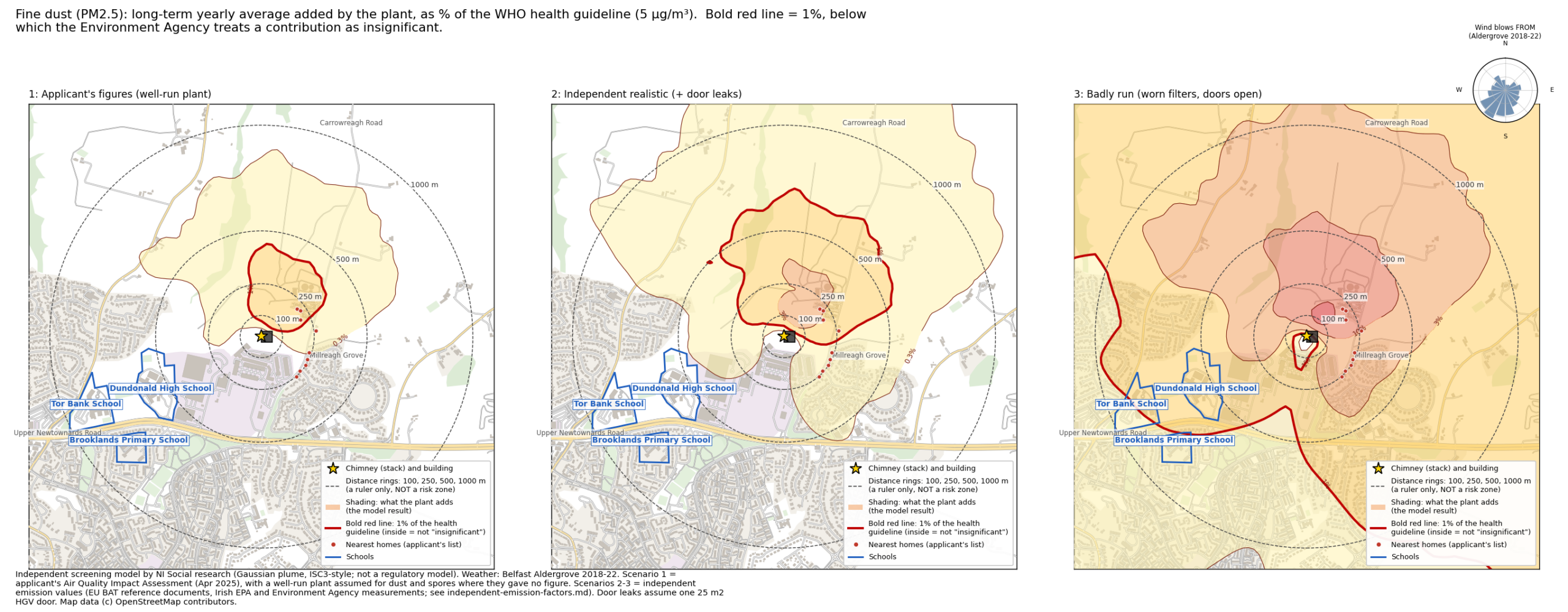
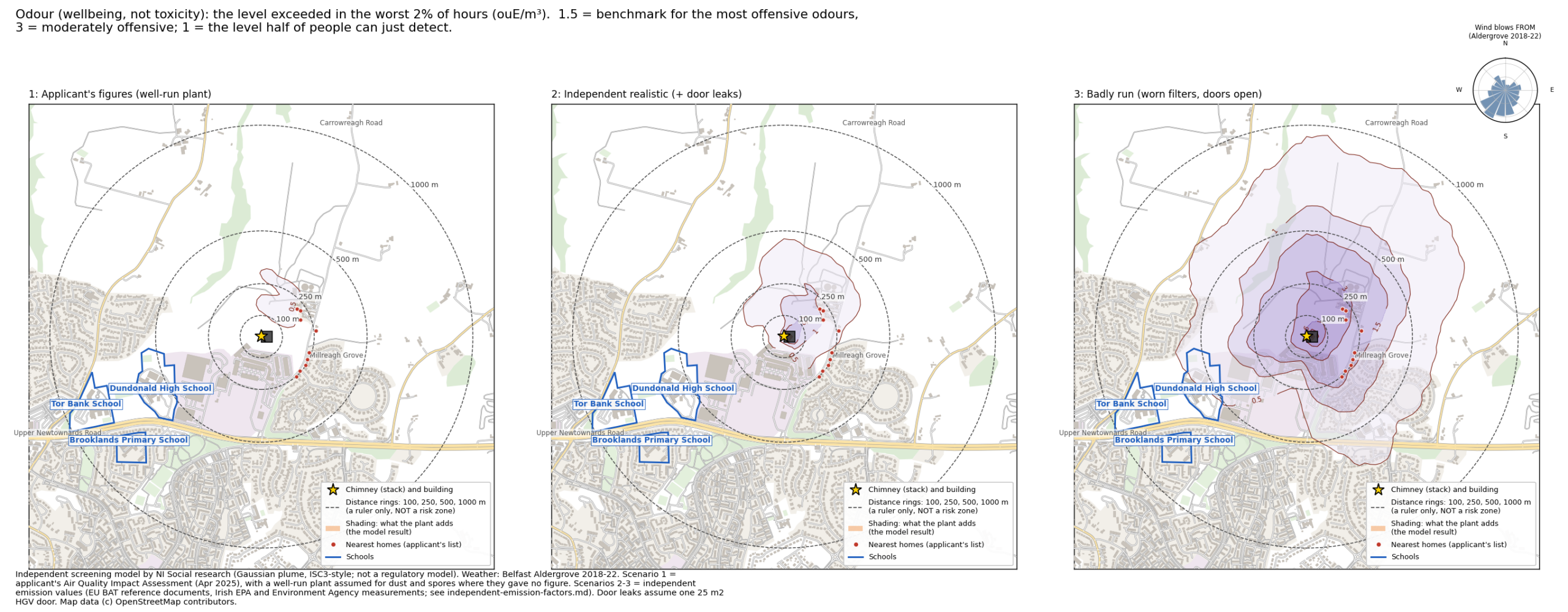
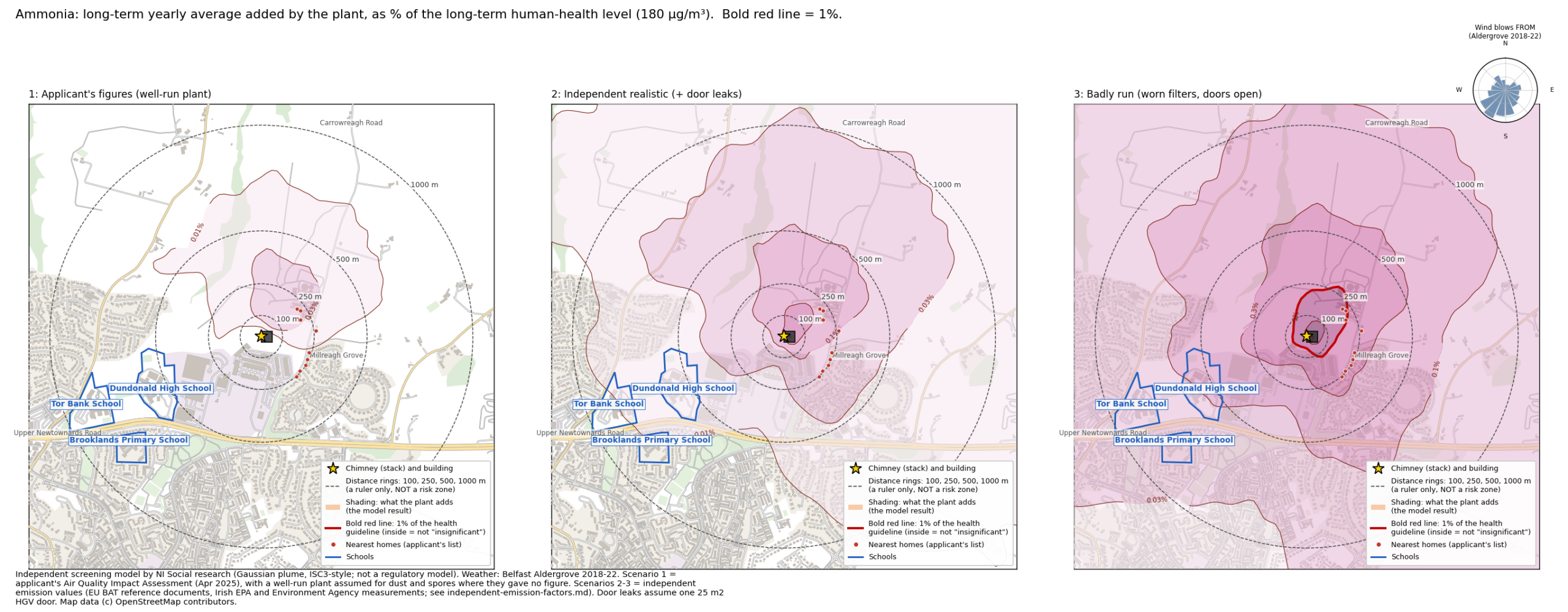
- The yellow star is the chimney, and the dark square is the building.
- The dashed circles mark 100, 250, 500 and 1,000 m from the chimney. They are a ruler for distance only. They do not show risk.
- The coloured shading is the model’s result: what the plant adds to the air, and where. It is not round because the wind in this part of Northern Ireland comes mostly from the south-west, which pushes the plant’s emissions to the north and north-east, towards Carrowreagh Road and the fields below the Craigantlet hills.
- The bold red line on the dust maps is the 1% line. Inside it, the plant adds more than 1% of the World Health Organization’s long-term guideline for fine dust. The Environment Agency treats anything below 1% of a long-term standard as insignificant. Inside the line, a contribution needs a proper look. It does not mean harm.
- Red dots are the nearest homes listed in the applicant’s report, and blue outlines are schools.
- The wind rose shows how often the wind blows from each direction.
What our model found
Fine dust (PM2.5) is the pollutant most firmly linked to long-term health effects, and the one the application does not assess. The air in this part of Dundonald already carries about 5.3 micrograms per cubic metre of fine dust on Defra’s official background maps. What the plant would add each year, as a share of that:
| 1: Applicant’s figures | 2: Independent realistic | 3: Badly run | |
|---|---|---|---|
| Nearest homes on Carrowreagh Road | +1% | +3% | +19 to 24% |
| Millreagh Grove | +0.3% | +0.6% | +4 to 5% |
| Dundonald High School (nearest edge) | +0.1% | +0.3% | +2% |
| Tor Bank School and Brooklands Primary | +0.1% | +0.1% | +1% |
Smell (for comparison; smell affects wellbeing rather than causing disease). In the worst 2% of hours at the nearest Carrowreagh Road homes: 0.5 odour units in scenario 1, 1.0 in scenario 2 (roughly the level where half of people can just detect it), and 3.4 in scenario 3, above both of the usual planning benchmarks (1.5 for the most offensive smells and 3 for moderately offensive ones). At Millreagh Grove, scenario 3 gives 1.7 to 1.9.
Ammonia: at most about 1% of the long-term human health level anywhere, even in scenario 3.
Airborne spores (Aspergillus fumigatus, a common mould): too small to measure against normal outdoor levels in scenarios 1 and 2. In scenario 3, the worst hours at the nearest Carrowreagh Road homes could reach levels comparable to, or above, a typical outdoor background, while staying well under the Environment Agency’s “acceptable” level of 500 per cubic metre.
Night-time noise (from the applicant’s own noise report, not our model): the plant is predicted at 35 to 37 decibels outside the nearest homes at night, about 3 decibels above the quietest existing night-time background. That would be audible in quiet spells and sits at the level the World Health Organization associates with the start of complaints. Environmental Health has not accepted the report and asked for it to be redone with stricter assumptions. With the doors open at night, the plant would be clearly audible over the background.
Lorries: about 26 movements on working days, averaging about 18 a day across the year. That is below the usual screening level for assessing traffic fumes, and about a 2.4% increase on Carrowreagh Road.
What it could mean for long-term health
Fine dust has well-established links to heart disease, stroke, lung disease and shortened lives, and no level has been found below which it is harmless. The UK’s official method for estimating the effect of long-term fine dust gives these changes in long-term risk for people living at the nearest Carrowreagh Road homes:
- Scenario 1: about +0.05%.
- Scenario 2: about +0.1%.
- Scenario 3: about +0.8 to 1%. Using other published studies, the range is about +0.25% to +3.5%.
None of these could be detected in any individual person. They are statistics across a population, and scenario 3 only applies if the plant ran badly, continuously, for years. At every school, the effects are about a tenth or less of those at the nearest homes.
Noise at night is the other realistic long-term effect. Years of broken sleep are linked to poorer wellbeing and a small increase in heart risk. The applicant’s figures suggest a modest effect. Environmental Health’s corrections, or doors left open at night, would make it more significant for the nearest homes.
Spores: healthy people face no known risk at these levels. For people with cystic fibrosis, a mould allergy, or a weakened immune system, there is not enough evidence either way. Digestate is likely to carry fewer mould spores than compost, which is where most of the research comes from.
Stress and worry: research on people living beside contested industrial and waste sites shows real effects on wellbeing, even where measured pollution is low. Clear information and openness from the operator have been found to help.
What nobody has assessed yet
- The nearest home is about 180 m from the building. In England, permits for biogas and similar plants normally require extra assessment for homes within 200 m, and for bioaerosols within 250 m.
- The combined effect of this plant and the existing biogas plant on the same estate.
- The people who work in the business parks right beside the site.
- Endotoxins (bacterial toxins that can travel on dust).
- Dust escaping through the doors, which our model also leaves out because no data exists. That makes our dust figures, if anything, low.
What makes the difference
Almost everything that separates scenario 3 from scenarios 1 and 2 is the kind of thing planning conditions and an environmental permit can control. These are the points the council’s Environmental Health team and NIEA have raised, and that permits for similar plants in England commonly include:
- a legal limit on dust leaving the chimney, with regular monitoring
- keeping the building under negative pressure, so air flows in rather than out, with rules on how long doors can stay open
- an odour management plan, with a named person responsible and a complaints procedure
- limits on night-time deliveries and on noise at the nearest homes
- monitoring for bioaerosols, as some English permits already require for plants within 250 m of homes
Whether the plant should be approved is for the council to decide. What the evidence shows is that the answer to “is it safe?” depends less on the idea of the plant than on the controls attached to it and on how well it is run.
How to have your say, or follow the decision
The application is LA05/2025/0400/F on the Northern Ireland planning portal. The register page shows every document, every consultee response, the comments lodged, and whether comments are still being accepted. The decision will be made either by council planning officers or by Lisburn and Castlereagh City Council’s planning committee, whose agendas are published on the council’s website each month.
A note from us
NI Social lists Capparelli at the Mill, the restaurant in the restored Dundonald Old Mill. The mill building is owned by BH Estates, which also holds a stake in the restaurant’s operating company. We have no commercial relationship with BH Estates or the restaurant, and we did not know of the connection when we listed it.
How we did this
Our model is a steady-state Gaussian plume model in the style of the US EPA’s ISC3, run hourly for 2018 to 2022 on Aldergrove weather records (NOAA Integrated Surface Database), with building downwash, simple terrain from the EU-DEM elevation model, and a separate ground-level source for the doors. Emission figures for scenarios 2 and 3 come from EU reference documents on best available techniques, Irish EPA and Environment Agency guidance and measurements, and published studies. Health estimates use the UK Committee on the Medical Effects of Air Pollutants (COMEAP) coefficient for long-term fine dust and the World Health Organization’s 2021 air quality guidelines. Our code and full workings are kept on file and are available on request. Our weather data came from the NOAA Integrated Surface Database, background dust from Defra’s background maps for Northern Ireland, terrain from the EU-DEM elevation model, and map data from OpenStreetMap contributors.
Questions people ask
- What is being built on Carrowreagh Road in Dundonald?
- BH Estates has applied (LA05/2025/0400/F) for a building on fields off Carrowreagh Road that would blend dried digestate from biogas plants with mineral fertiliser and press it into pellets, up to 30,000 tonnes a year, running 24 hours a day with a 16.9 m chimney. It was lodged in June 2025 and is undecided.
- Who is behind the Carrowreagh Road fertiliser plant?
- The applicant is Blakiston Houston Estate Company Ltd (BH Estates), the Dundonald estate company based on Carrowreagh Road. The project is linked to a £4 million DAERA award, made in October 2024, to take excess phosphorus out of Northern Ireland's slurry.
- Has the Carrowreagh Road plant been approved?
- No. As of 29 September 2026 it was undecided. Council Environmental Health, NIEA and Shared Environmental Services had all asked the applicant for more information, and it had drawn 457 objections.
- Will the Carrowreagh Road plant affect people's health?
- Our independent modelling suggests that, run as described, it would add amounts of dust, ammonia and airborne spores too small to measure. If it were run badly for years, the nearest homes on Carrowreagh Road would see about a fifth more fine dust than they already breathe, and more night-time noise. The difference comes down to the controls attached to any permission and how well the plant is run.
- Will the Carrowreagh Road plant smell?
- On the applicant's figures, smell at the nearest homes would stay below the level most people can detect. With independent emission figures it reaches about the detection level in the worst 2% of hours; if badly run, it goes above the usual planning benchmarks at the nearest homes on Carrowreagh Road and Millreagh Grove.
- How close is the plant to Dundonald High School?
- About 430 m from the nearest edge of the school grounds, which lie mostly upwind of the prevailing south-westerly wind. In every scenario we modelled, the effects at the schools were about a tenth or less of those at the nearest homes.
- Does the Carrowreagh Road plant make biogas?
- No. On the applicant's account, it would blend and pelletise digestate that has already been through biogas plants elsewhere, and would not produce or store biogas. BH Estates runs a separate, permitted biogas plant on the same farm.
- Why was there no public consultation before the application?
- The site was sized at 0.98 hectares and 2,598 m² of floor space, just under the 1 hectare and 5,000 m² thresholds for a major development, so no pre-application notice or community consultation was required. The council decided it did not need a full environmental impact assessment.
- How can I comment on or follow the Carrowreagh Road application?
- The application is LA05/2025/0400/F on the Northern Ireland planning portal. The register page shows every document, the consultee responses, the comments lodged and whether comments are still being accepted.
Sources
- Planning register page
- DAERA: £4m award to the first SULS SBRI Phase 2 company
- Farm2Export: Ammonia (BH Estates and UK Centre for Ecology & Hydrology)
- NI Assembly Research and Information Service: Anaerobic Digestion in Northern Ireland
- World Health Organization: Global Air Quality Guidelines
- COMEAP: quantifying mortality from long-term exposure to PM2.5
- COMEAP: shape of the concentration-response curve for PM2.5
- Chief Medical Officer's Annual Report 2022: Air pollution
- IAQM: Guidance on the assessment of odour for planning
- Pearson et al.: exposure to bioaerosols from composting facilities, systematic review